



| Introduction | Why Grade Stamps? | What is Grading? | PSE Grading System | Soundness | Centering | Combining Soundness and Centering | Eye Appeal | Gum Condition | Appendix |
|
It should be noted that the philatelic community has not entirely ignored the question of grading. The key price guides contain a brief discussion of grading and condition, and most illustrate centering variations in the so-called "middle grades" of Fine through Extremely Fine. Other important factors however, such as the presence (or lack) of creases, thins, color fading, hinge remnants, gum condition, pinholes, stains, and other faults are mentioned only in passing-as having an "effect" on a stamp's value. How much, is usually left to the imagination of the seller and buyer.
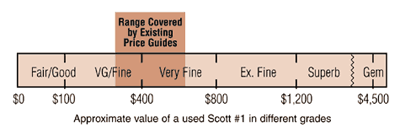
The major price guides are similarly inadequate in communicating the full range of market value a given stamp can enjoy. As an example, let's take a stamp most collectors are familiar with; a used copy of the 5¢ issue of 1847, Scott #1.
The 2002 Scott Specialized catalog lists the stamp in one grade:
Very Fine at $600. Scott's Pocket Guide adds a Fine column at $475. Brookman's lists the stamp at $300 and $475 in Average and Fine condition, respectively. Brookman notes a 50% premium in VF, yielding a computed value of approximately $700. However, faulty copies of this stamp are widely available on the internet as low as $75 to $100, and gem examples can bring prices up to $4,500 in major auctions. So we see that the available price guides report a range of $300 to $700 for a stamp which trades in the marketplace at all levels between $75 and $4,500. Hardly adequate coverage.